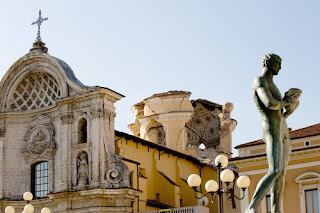
 (VINCENZO PINTO, AFP/Getty Images / April 6, 2009)
The dome of the Cathedral in the center of L'Aquila was damaged by an earthquake measuring 5.8-magnitude on the Richter scale. The death toll was rising steadily after many homes collapsed in the Abruzzo region.
I don't know if you guys will recall it but, back on February there was a clue in the old TMS XW for which the answer was 'spruce'. Argyle, who guess blogged that puzzle commented that both the noun [spruce: any evergreen, coniferous tree of the genus Picea] and the verb [spruce: trim in dress or appearance; neat; smart; dapper] came from the same root, Prussia. I mentioned in my subsequent comment that I found that very interesting since I had never made a connection between the two homonyms, much less any connection to Prussia. I also commented that whenever I think of Prussia I always recall the Hohenstaufen dynasty and, specifically, the Holy Roman Emperor Frederick II. So, you might ask, what does this have to do with the earthquake in central Italy? Well, in my comment I included the following quote from Wikipedia that points out Frederick II's contribution to poetry.
"He was patron of the Sicilian School of poetry. His royal court in Palermo, from around 1220 to his death, saw the first use of a literary form of an Italo-Romance language, Sicilian. The poetry that emanated from the school predates the use of the Tuscan idiom as the preferred language of the Italian peninsula by at least a century. The school and its poetry were well known to Dante and his peers and had a significant influence on the literary form of what was eventually to become the modern Italian language."
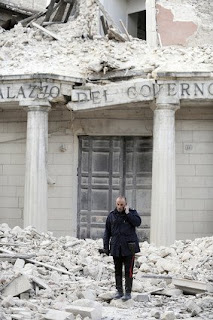 OK so, once again, what does this have to do with the earthquake in Italy? Well, apart from being a great patron of poets, he was also a patron of the other arts as well as architecture. He was the one who began the construction of the city of L'Aquila.
According to the story from the Associated Press, in the historic center of the city, a wall of the 13th century Santa Maria di Collemaggio church collapsed and the bell tower of the Renaissance San Bernadino church also fell. The 16th-century castle housing the Abruzzo National Museum was damaged. The story also mentioned that firefighters with dogs worked feverishly to reach people trapped in fallen buildings, including a dormitory where half a dozen university students were believed still inside. Castelnuovo, a hamlet of about 300 people 25 kilometers (15 miles) southeast of L'Aquila, appeared hard hit, and five were confirmed dead there. Another small town, Onno, was almost completely leveled. It is possible that the university buildings are quite old as are, no doubt, the buildings in those nearby towns. While many famous structures, such as the Ponte Vecchio, have been spared the ravages of time, many have not and it is always a shame to see this kind of thing happen.
The last major quake to hit central Italy was a 5.4-magnitude temblor that struck the south-central Molise region on Oct. 31, 2002, killing 28 people, including 27 children who died when their school collapsed. I remember that one well. It was just a small town that lost so many of its children. Very sad.
